Could Bitcoin (BTC) emerge as a long-term winner, regardless of whether the artificial intelligence (AI) revolution succeeds or the investment bubble eventually bursts?
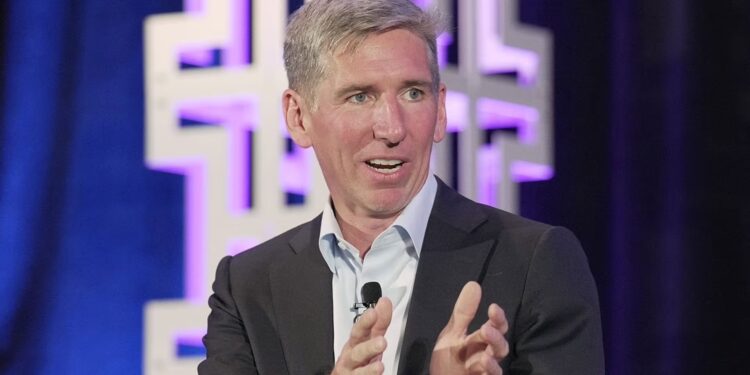
Matt Hougan, Chief Investment Officer at crypto asset management firm Bitwise, has shared his latest perspective, outlining three distinct economic scenarios—all of which lead to the same conclusion: an AI-driven productivity boom would enhance the value of scarce assets; a bubble burst could trigger monetary easing; and even in a scenario of steady economic growth, Bitcoin stands to benefit from institutional adoption.
The AI Boom: As Goods Become Cheaper, Does Bitcoin Become Scarcer?
Hougan begins by positing a scenario where AI technological breakthroughs drive a massive surge in productivity and economic growth, significantly lowering the costs of knowledge-based services—such as software, legal work, design, and healthcare.
In this environment, he suggests that the market might allocate more wealth toward assets with inelastic supply—including gold, fine art, prime real estate, and Bitcoin.
Given that Bitcoin’s total supply is capped at 21 million, Hougan argues that as other goods and services become increasingly abundant, the scarcity of BTC may be valued even more highly.
However, scarcity alone does not guarantee price appreciation; Bitcoin still requires sustained investment demand to translate its supply constraints into market value.
An AI Bubble Burst: A Potential Initial Plunge, Followed by a Rebound via Government Intervention
The second scenario is more controversial. Hougan hypothesizes that if the massive investments poured into AI infrastructure fail to yield sufficient returns, borrowers—such as those behind data centers—could default. This would place pressure on the insurance companies and financial institutions holding the associated debt, potentially triggering a financial crisis akin to the one seen in 2008.
In such a scenario, Bitcoin might initially plummet in tandem with the broader stock market. Yet, Hougan believes that because AI has become a critical strategic industry, the U.S. government would almost certainly intervene—implementing measures such as interest rate cuts, expanding the central bank’s balance sheet, and providing direct financial support. He even estimates—based on his own assessment—that the probability of government market intervention is close to 100%.
Should this lead to a significant expansion in the money supply, he expects Bitcoin—with its fixed-supply nature—to benefit once again, potentially triggering a strong rebound.
However, there remains uncertainty regarding whether the government will intervene, the scale of any such intervention, and whether any of those funds would actually flow into Bitcoin. Even if central banks shift toward a more accommodative policy, there is no guarantee that the price of Bitcoin will rise immediately.
Economic “Soft Landing”: ETFs and Corporate Reserves Continue to Support Bitcoin
A third scenario involves no dramatic economic shifts. Hougan posits a scenario where AI drives moderate productivity gains without fundamentally altering the economic structure; the economy maintains a growth rate of around 3% with interest rates near 4%, and corporations remain capable of servicing the debt incurred from their AI-related investments.
In this relatively stable environment, he argues that Bitcoin does not need a major financial crisis to thrive. Instead, it could continue to benefit from inflows into spot ETFs, adoption by financial advisors, and the integration of Bitcoin into the balance sheets of corporations and sovereign institutions.
Consequently, Hougan suggests that investors may be placing too much emphasis on short-term macroeconomic fluctuations, while overlooking the long-term trend of growing Bitcoin adoption.
IMF Warns That a Retreat in AI Investment Could Drag Down the Global Economy
It is worth noting that Bitwise’s optimistic outlook contrasts with a recent warning issued by the International Monetary Fund (IMF).
The IMF’s latest World Economic Outlook notes that while investment in AI infrastructure is currently propping up global growth, a sharp correction in AI-related spending could leave global GDP approximately 1.1% lower by 2028 compared to the baseline scenario—with the U.S. economy potentially facing an even greater impact.
This highlights a key risk to the Bitwise thesis: if an “AI bubble” were to burst and trigger financial stress, Bitcoin might not function as a hedge in the short term; rather, it could face sell-offs as investors scramble for cash.
Hougan himself acknowledges that Bitcoin will not necessarily rise under every possible scenario. He cited the 2020 pandemic-induced panic—during which BTC plummeted by approximately 50% in just a few days—as an example, reminding investors that a long-term bullish outlook can coexist with the potential for significant short-term losses.
BTC Rebounds to $82,000; Bitwise’s Long-Term Bullish Thesis Faces Market Test
Regarding market performance, the latest verifiable snapshot from Binance on October 16 shows Bitcoin trading at approximately $82,002—a 1.31% increase over the previous 24 hours. The asset had earlier dipped to $79,736 before recovering to the $82,000 level. Nevertheless, BTC remains down by about 35% from its all-time high of approximately $126,198, underscoring that market volatility and macroeconomic pressures remain significant.